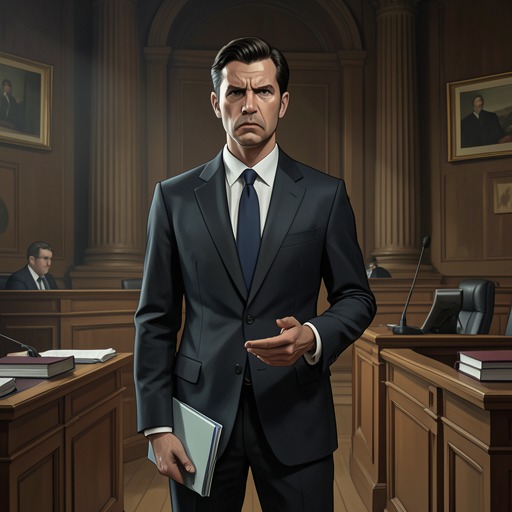
Mistrial motion after William Barber is mentioned at trial
Defending JacobThe mistrial motion after William Barber is mentioned at trial arose when prosecutor Neal Logiudice asked Andrew Barber, the defendant’s father, when he had learned that his own father was a murderer. The question violated a boundary the judge had expressly established before trial and forced the court to confront whether the jury could set aside the implication that Jacob Barber might be guilty by inheritance. Jonathan Klein moved for a mistrial; the judge denied it, recorded the objection for appeal, and ordered that the subject not be raised again.
The question and the boundary
The exchange came during the trial’s questioning of Andrew Barber. Logiudice asked when Andrew had learned that his father was a murderer. Andrew did not answer: Klein and Andrew both rose at once to object, and the judge sustained the objection, instructed the witness not to respond, and told the jury to give the question no weight and treat it as though it had never been asked.
The judge then called counsel to the bench. Andrew was not present at the sidebar, so his account of the judge’s words comes from the trial transcript; he nevertheless observed that the judge was visibly furious. The judge reminded Logiudice that he had been explicitly told not to raise the subject and had been warned that doing so would result in a mistrial. Logiudice defended his question as a response to the defense’s own cross-examination about Andrew’s character and the integrity of the investigation, but that explanation did not erase the court’s prior restriction.
The defense motion
After the jury left the courtroom, Klein formally moved for a mistrial. He described the issue as the subject of extensive pretrial discussion and argued that its volatility and prejudicial force were precisely why the judge had prohibited it. His image for the restriction was the “third rail”: a subject the prosecution had been explicitly warned not to touch.
Klein also identified the alternative if the trial continued without a mistrial. The defense would expand its witness list to include Leonard Patz and William Barber. When the judge confirmed that William Barber was Jacob’s grandfather, Klein said the defense might need a governor’s warrant to bring him to court. The proposed witnesses would answer the prosecution’s insinuation that Jacob’s guilt could be inferred from membership in a criminal family—that he was, in Klein’s formulation, born a murderer. The motion therefore concerned not only the improper question itself but the danger that family history would operate as a substitute for proof of Jacob’s own responsibility.
The trial’s competing stories
The question landed in a trial already shaped by rival accounts of how to understand the murder. In his opening, Logiudice urged the jury to organize the evidence into a story about a well-provided-for teenager with a lethal temper who was pushed until he snapped. His account acknowledged uncertainty about the precise trigger, but argued that jurors would want an explanation for how a boy with no known history of violence could commit such a brutal act. The narrator observes that Logiudice could offer only theories and probabilities about what might have provoked Jacob.
Against that uncertainty, the reference to Andrew’s father threatened to make lineage seem like an answer: not a proved motive or a demonstrated act, but a ready-made story about inherited criminality. Klein’s proposed witnesses made the implication explicit by seeking to rebut the suggestion that Jacob was guilty because he belonged to a criminal family. The episode exposes the tension between the prosecution’s need to give jurors a coherent story and the legal limits on what may fairly count as evidence against an individual defendant.
Denial and continuation
At nine o’clock the next morning, Judge French denied the mistrial motion. He noted the objection for the record and preserved the issue for appeal, said that he had given the jury a curative instruction, and cautioned Logiudice not to mention the subject again. The jury was brought back, and the trial went on.
Andrew says he was not surprised by the ruling: mistrials were rare, and the court had a substantial investment in bringing the trial to completion. He also considers the possibility that Logiudice knowingly crossed the line because the high stakes made a mistrial seem unlikely, but immediately marks that interpretation as unkind. The denial contained the disruption without resolving the underlying concern; the objection remained preserved, while the courtroom returned to the ordinary business of the trial.
Significance
The motion crystallizes a central uncertainty in the case: whether Jacob should be judged by evidence about his own conduct or by a family history that makes violence appear inherited and inevitable. The trial’s rhetoric had already pressed the jury to see a sudden act as the culmination of a story; the forbidden question risked turning that story into a claim about bloodline. The judge’s warning and the preserved appellate objection draw a boundary around that move, but the question has already been spoken in the jury’s presence.
That unresolved distinction also belongs to Andrew’s retrospective account of the trial. He repeatedly recognizes how courtroom arguments shape what jurors are invited to see: not just facts, but a narrative that makes the facts seem to point in one direction. Here the procedural outcome is clear—the motion was denied and the trial continued—while the episode’s larger uncertainty persists: how much a jury can disregard once a forbidden family story has entered the room.